
From the Desk of Melissa Irace, CISO
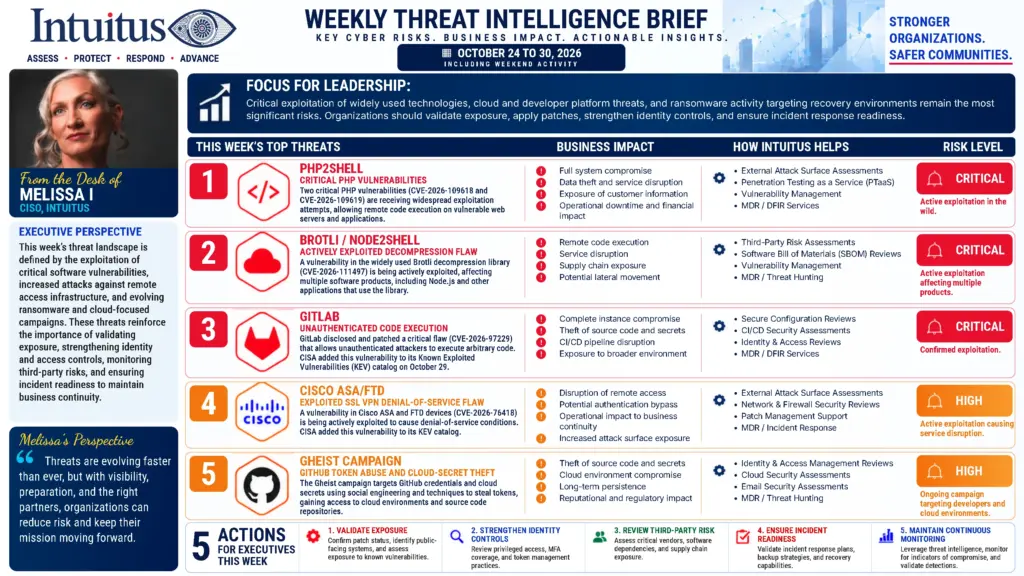
Critical exploitation of widely used technologies, cloud and developer platform threats, and ransomware activity targeting recovery environments remain the most significant risks. Organizations should validate exposure, apply patches, strengthen identity controls, and ensure incident response readiness.
Executive perspective
This week’s threat landscape is defined by the exploitation of critical software vulnerabilities, increased attacks against remote access infrastructure, and evolving ransomware and cloud-focused campaigns.
These threats reinforce the importance of validating exposure, strengthening identity and access controls, monitoring third-party risks, and ensuring incident readiness to maintain business continuity.
Melissa’s perspective
“Threats are evolving faster than ever, but with visibility, preparation, and the right partners, organizations can reduce risk and keep their mission moving forward.”
This week’s top threats
01 · Critical
PHP2Shell: critical PHP vulnerabilities
Two critical PHP vulnerabilities (CVE-2026-109618 and CVE-2026-109619) are receiving widespread exploitation attempts, allowing remote code execution on vulnerable web servers and applications.
How Intuitus helps
- External Attack Surface Assessments
- Penetration Testing as a Service (PTaaS)
- Vulnerability Management
- MDR and DFIR Services
02 · Critical
Brotli and Node2Shell: an exploited decompression flaw
A vulnerability in the widely used Brotli decompression library (CVE-2026-111497) is being actively exploited, affecting multiple software products, including Node.js and other applications that use the library.
How Intuitus helps
- Third-Party Risk Assessments
- Software Bill of Materials (SBOM) Reviews
- Vulnerability Management
- MDR and Threat Hunting
03 · Critical
GitLab: unauthenticated code execution
GitLab disclosed and patched a critical flaw (CVE-2026-97229) that allows unauthenticated attackers to execute arbitrary code. CISA added this vulnerability to its Known Exploited Vulnerabilities (KEV) catalog on 29 October.
How Intuitus helps
- Secure Configuration Reviews
- CI/CD Security Assessments
- Identity and Access Reviews
- MDR and DFIR Services
04 · High
Cisco ASA and FTD: exploited SSL VPN denial of service
A vulnerability in Cisco ASA and FTD devices (CVE-2026-76418) is being actively exploited to cause denial-of-service conditions. CISA added this vulnerability to its KEV catalog.
How Intuitus helps
- External Attack Surface Assessments
- Network and Firewall Security Reviews
- Patch Management Support
- MDR and Incident Response
05 · High
Gheist campaign: GitHub token abuse and cloud-secret theft
The Gheist campaign targets GitHub credentials and cloud secrets using social engineering and techniques to steal tokens, gaining access to cloud environments and source code repositories.
How Intuitus helps
- Identity and Access Management Reviews
- Cloud Security Assessments
- Email Security Assessments
- MDR and Threat Hunting
Five actions for executives this week
- Validate exposure. Confirm patch status, identify public-facing systems, and assess exposure to known vulnerabilities.
- Strengthen identity controls. Review privileged access, MFA coverage, and token management practices.
- Review third-party risk. Assess critical vendors, software dependencies, and supply chain exposure.
- Ensure incident readiness. Validate incident response plans, backup strategies, and recovery capabilities.
- Maintain continuous monitoring. Use threat intelligence, monitor for indicators of compromise, and validate detections.