
From the Desk of Melissa Irace, CISO
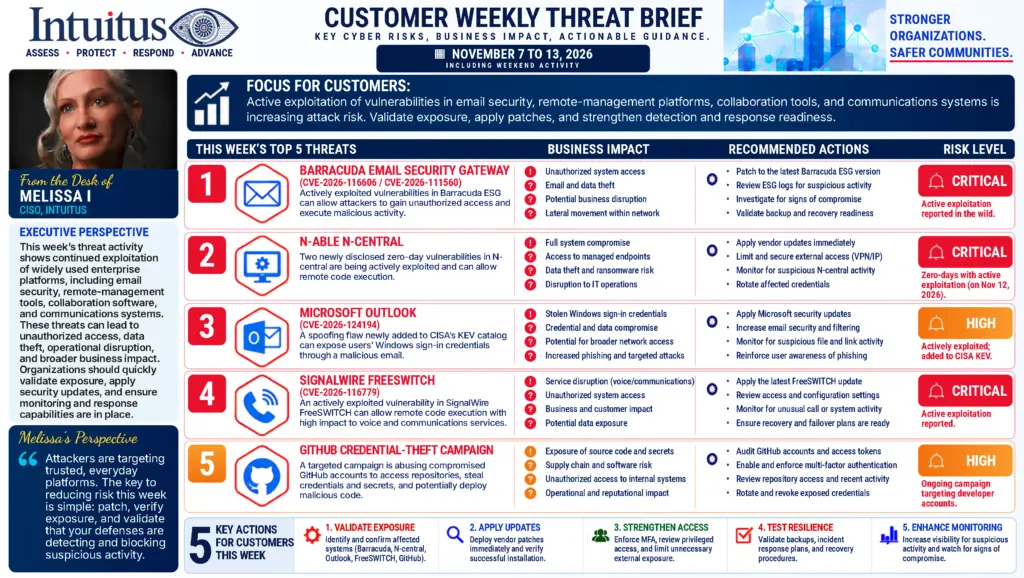
Active exploitation of vulnerabilities in email security, remote-management platforms, collaboration tools, and communications systems is increasing attack risk. Validate exposure, apply patches, and strengthen detection and response readiness.
Executive perspective
This week’s threat activity shows continued exploitation of widely used enterprise platforms, including email security, remote-management tools, collaboration software, and communications systems. These threats can lead to unauthorized access, data theft, operational disruption, and broader business impact.
Organizations should quickly validate exposure, apply security updates, and ensure monitoring and response capabilities are in place.
Melissa’s perspective
“Attackers are targeting trusted, everyday platforms. The key to reducing risk this week is simple: patch, verify exposure, and validate that your defenses are detecting and blocking suspicious activity.”
This week’s top threats
01 · Critical
Barracuda Email Security Gateway
Actively exploited vulnerabilities in Barracuda ESG (CVE-2026-116606 and CVE-2026-111560) can allow attackers to gain unauthorized access and execute malicious activity.
Recommended actions
- Patch to the latest Barracuda ESG version
- Review ESG logs for suspicious activity
- Investigate for signs of compromise
- Validate backup and recovery readiness
02 · Critical
N-able N-central
Two newly disclosed zero-day vulnerabilities in N-central are being actively exploited and can allow remote code execution. Active exploitation was reported on 12 November 2026.
Recommended actions
- Apply vendor updates immediately
- Limit and secure external access (VPN or IP allow lists)
- Monitor for suspicious N-central activity
- Rotate affected credentials
03 · High
Microsoft Outlook
A spoofing flaw newly added to CISA’s Known Exploited Vulnerabilities catalog (CVE-2026-124194) can expose users’ Windows sign-in credentials through a malicious email.
Recommended actions
- Apply Microsoft security updates
- Increase email security and filtering
- Monitor for suspicious file and link activity
- Reinforce user awareness of phishing
04 · Critical
SignalWire FreeSWITCH
An actively exploited vulnerability in SignalWire FreeSWITCH (CVE-2026-116779) can allow remote code execution with high impact to voice and communications services.
Recommended actions
- Apply the latest FreeSWITCH update
- Review access and configuration settings
- Monitor for unusual call or system activity
- Ensure recovery and failover plans are ready
05 · High
GitHub credential-theft campaign
A targeted campaign is abusing compromised GitHub accounts to access repositories, steal credentials and secrets, and potentially deploy malicious code.
Recommended actions
- Audit GitHub accounts and access tokens
- Enable and enforce multi-factor authentication
- Review repository access and recent activity
- Rotate and revoke exposed credentials
Five key actions for customers this week
- Validate exposure. Identify and confirm affected systems, including Barracuda, N-central, Outlook, FreeSWITCH, and GitHub.
- Apply updates. Deploy vendor patches immediately and verify successful installation.
- Strengthen access. Enforce MFA, review privileged access, and limit unnecessary external exposure.
- Test resilience. Validate backups, incident response plans, and recovery procedures.
- Enhance monitoring. Increase visibility for suspicious activity and watch for signs of compromise.