
From the Desk of Melissa Irace, CISO
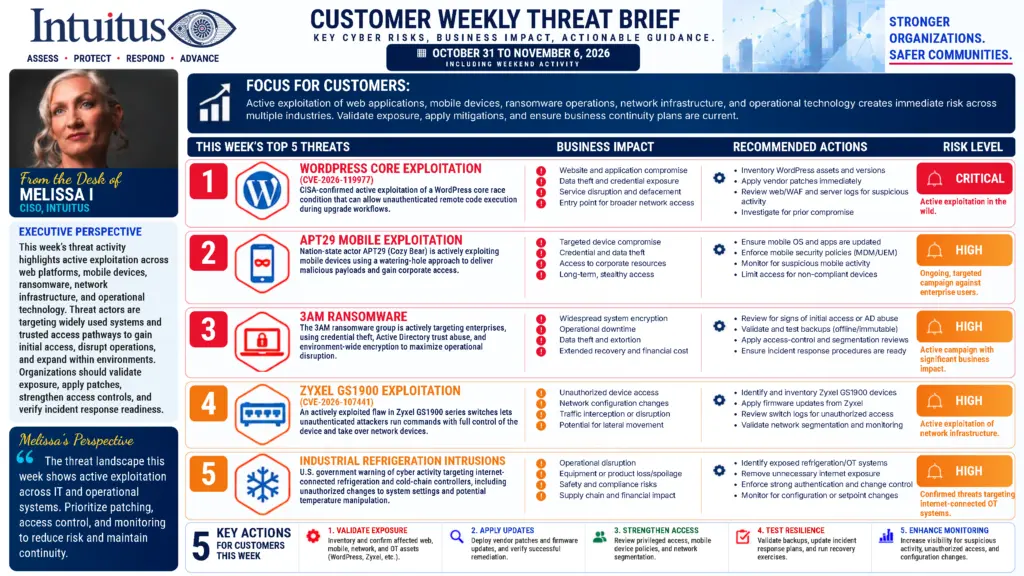
Active exploitation of web applications, mobile devices, ransomware operations, network infrastructure, and operational technology creates immediate risk across multiple industries. Validate exposure, apply mitigations, and ensure business continuity plans are current.
Executive perspective
This week’s threat activity highlights active exploitation across web platforms, mobile devices, ransomware, network infrastructure, and operational technology. Threat actors are targeting widely used systems and trusted access pathways to gain initial access, disrupt operations, and expand within environments.
Organizations should validate exposure, apply patches, strengthen access controls, and verify incident response readiness.
Melissa’s perspective
“The threat landscape this week shows active exploitation across IT and operational systems. Prioritize patching, access control, and monitoring to reduce risk and maintain continuity.”
This week’s top threats
01 · Critical
WordPress core exploitation
CISA-confirmed active exploitation of a WordPress core race condition (CVE-2026-119977) that can allow unauthenticated remote code execution during upgrade workflows.
Recommended actions
- Inventory WordPress assets and versions
- Apply vendor patches immediately
- Review web, WAF and server logs for suspicious activity
- Investigate for prior compromise
02 · High
APT29 mobile exploitation
Nation-state actor APT29 (Cozy Bear) is actively exploiting mobile devices using a watering-hole approach to deliver malicious payloads and gain corporate access.
Recommended actions
- Ensure mobile OS and apps are updated
- Enforce mobile security policies (MDM/UEM)
- Monitor for suspicious mobile activity
- Limit access for non-compliant devices
03 · High
3AM ransomware
The 3AM ransomware group is actively targeting enterprises, using credential theft, Active Directory trust abuse, and environment-wide encryption to maximize operational disruption.
Recommended actions
- Review for signs of initial access or Active Directory abuse
- Validate and test backups (offline or immutable)
- Apply access-control and segmentation reviews
- Ensure incident response procedures are ready
04 · High
Zyxel GS1900 exploitation
An actively exploited flaw in Zyxel GS1900 series switches (CVE-2026-107441) lets unauthenticated attackers run commands with full control of the device and take over network devices.
Recommended actions
- Identify and inventory Zyxel GS1900 devices
- Apply firmware updates from Zyxel
- Review switch logs for unauthorized access
- Validate network segmentation and monitoring
05 · High
Industrial refrigeration intrusions
A U.S. government warning of cyber activity targeting internet-connected refrigeration and cold-chain controllers, including unauthorized changes to system settings and potential temperature manipulation.
Recommended actions
- Identify exposed refrigeration and OT systems
- Remove unnecessary internet exposure
- Enforce strong authentication and change control
- Monitor for configuration or setpoint changes
Five key actions for customers this week
- Validate exposure. Inventory and confirm affected web, mobile, network, and OT assets, including WordPress and Zyxel.
- Apply updates. Deploy vendor patches and firmware updates, and verify successful remediation.
- Strengthen access. Review privileged access, mobile device policies, and network segmentation.
- Test resilience. Validate backups, update incident response plans, and run recovery exercises.
- Enhance monitoring. Increase visibility for suspicious activity, unauthorized access, and configuration changes.