
Phase 2 remains suspended. Federal News Network has published previously undisclosed recommendations from the Department of War’s CMMC Reform Task Force, but DoW has not announced a final decision on restarting, restructuring, or replacing CMMC Phase 2.
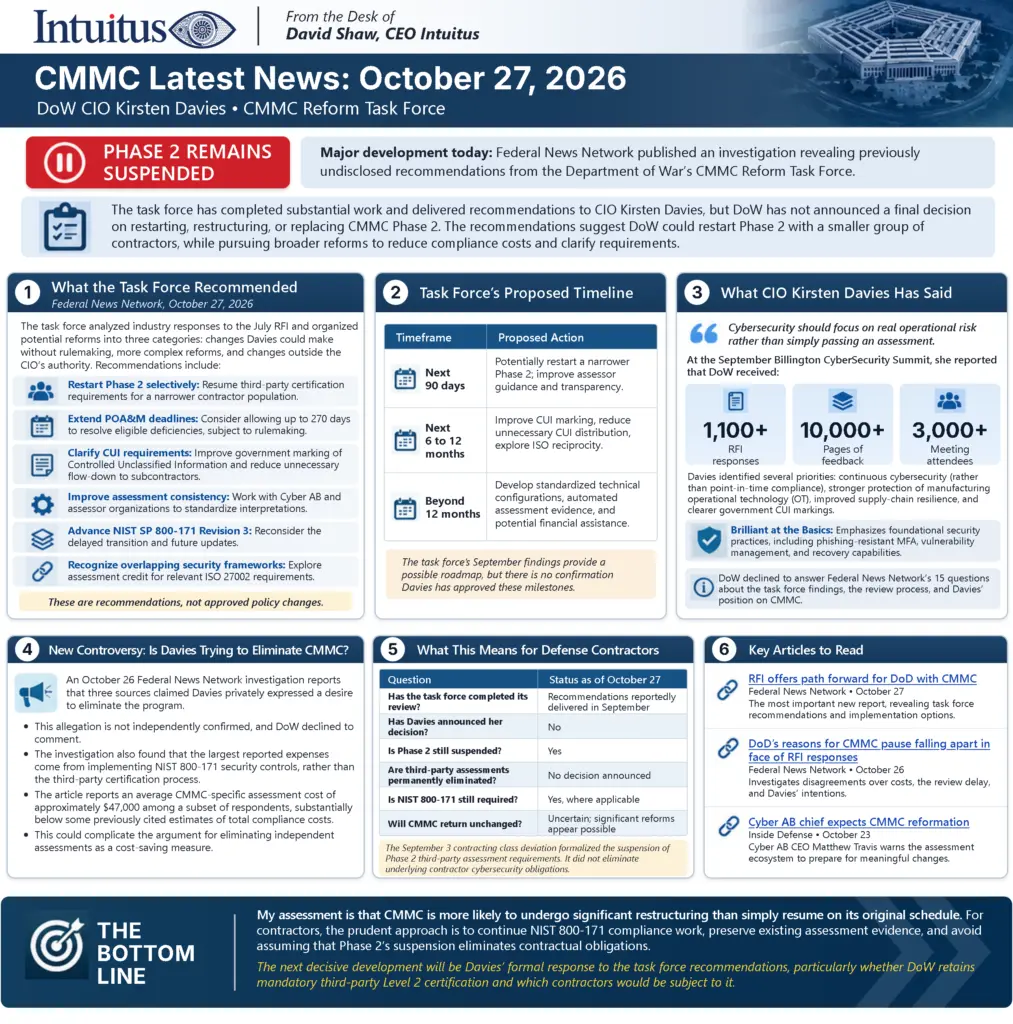
The task force has completed substantial work and delivered recommendations to DoW CIO Kirsten Davies. The recommendations suggest DoW could restart Phase 2 with a smaller group of contractors, while pursuing broader reforms to reduce compliance costs and clarify requirements.
What the task force recommended
The task force analyzed industry responses to the July RFI and organized potential reforms into three categories: changes Davies could make without rulemaking, more complex reforms, and changes outside the CIO’s authority. Recommendations include (Federal News Network, 27 October 2026):
- Restart Phase 2 selectively. Resume third-party certification requirements for a narrower contractor population.
- Extend POA&M deadlines. Consider allowing up to 270 days to resolve eligible deficiencies, subject to rulemaking.
- Clarify CUI requirements. Improve government marking of Controlled Unclassified Information and reduce unnecessary flow-down to subcontractors.
- Improve assessment consistency. Work with the Cyber AB and assessor organizations to standardize interpretations.
- Advance NIST SP 800-171 Revision 3. Reconsider the delayed transition and future updates.
- Recognize overlapping security frameworks. Explore assessment credit for relevant ISO 27002 requirements.
These are recommendations, not approved policy changes.
The task force’s proposed timeline
- Next 90 days: potentially restart a narrower Phase 2; improve assessor guidance and transparency.
- Next 6 to 12 months: improve CUI marking, reduce unnecessary CUI distribution, explore ISO reciprocity.
- Beyond 12 months: develop standardized technical configurations, automated assessment evidence, and potential financial assistance.
The task force’s September findings provide a possible roadmap, but there is no confirmation Davies has approved these milestones.
What CIO Kirsten Davies has said
Cybersecurity should focus on real operational risk rather than simply passing an assessment. At the September Billington CyberSecurity Summit, she reported that DoW received more than 1,100 RFI responses, more than 10,000 pages of feedback, and more than 3,000 meeting attendees.
Davies identified several priorities: continuous cybersecurity rather than point-in-time compliance, stronger protection of manufacturing operational technology (OT), improved supply-chain resilience, and clearer government CUI markings. Her “Brilliant at the Basics” message emphasizes foundational security practices, including phishing-resistant MFA, vulnerability management, and recovery capabilities.
DoW declined to answer Federal News Network’s 15 questions about the task force findings, the review process, and Davies’ position on CMMC.
New controversy: is Davies trying to eliminate CMMC?
A 26 October Federal News Network investigation reports that three sources claimed Davies privately expressed a desire to eliminate the program. This allegation is not independently confirmed, and DoW declined to comment.
The investigation also found that the largest reported expenses come from implementing NIST 800-171 security controls, rather than the third-party certification process. The article reports an average CMMC-specific assessment cost of approximately $47,000 among a subset of respondents, substantially below some previously cited estimates of total compliance costs. This could complicate the argument for eliminating independent assessments as a cost-saving measure.
What this means for defense contractors
Status as of 27 October:
- Has the task force completed its review? Recommendations were reportedly delivered in September.
- Has Davies announced her decision? No.
- Is Phase 2 still suspended? Yes.
- Are third-party assessments permanently eliminated? No decision announced.
- Is NIST 800-171 still required? Yes, where applicable.
- Will CMMC return unchanged? Uncertain; significant reforms appear possible.
The 3 September contracting class deviation formalized the suspension of Phase 2 third-party assessment requirements. It did not eliminate underlying contractor cybersecurity obligations.
Bottom line
My assessment is that CMMC is more likely to undergo significant restructuring than simply resume on its original schedule. For contractors, the prudent approach is to continue NIST 800-171 compliance work, preserve existing assessment evidence, and avoid assuming that Phase 2’s suspension eliminates contractual obligations.
The next decisive development will be Davies’ formal response to the task force recommendations, particularly whether DoW retains mandatory third-party Level 2 certification and which contractors would be subject to it.
Key articles to read
- “RFI offers path forward for DoD with CMMC”, Federal News Network, 27 October. The most important new report, revealing task force recommendations and implementation options.
- “DoD’s reasons for CMMC pause falling apart in face of RFI responses”, Federal News Network, 26 October. Investigates disagreements over costs, the review delay, and Davies’ intentions.
- “Cyber AB chief expects CMMC reformation”, Inside Defense, 23 October. Cyber AB CEO Matthew Travis warns the assessment ecosystem to prepare for meaningful changes.
This content is provided for general informational purposes only and does not constitute legal, regulatory, or contractual advice. Readers should consult official government sources and qualified legal counsel for matters specific to their organization or contracts.