
Over the past two weeks, we’ve seen something that should get the attention of every business owner and executive in this country. Some of the largest technology companies and service providers in the world have experienced significant operational failures. Microsoft 365, Amazon Web Services, the FAA, JPMorgan Chase, United Airlines, AT&T, Workday, Apple, Marriott, and others have all experienced disruptions of varying degrees.
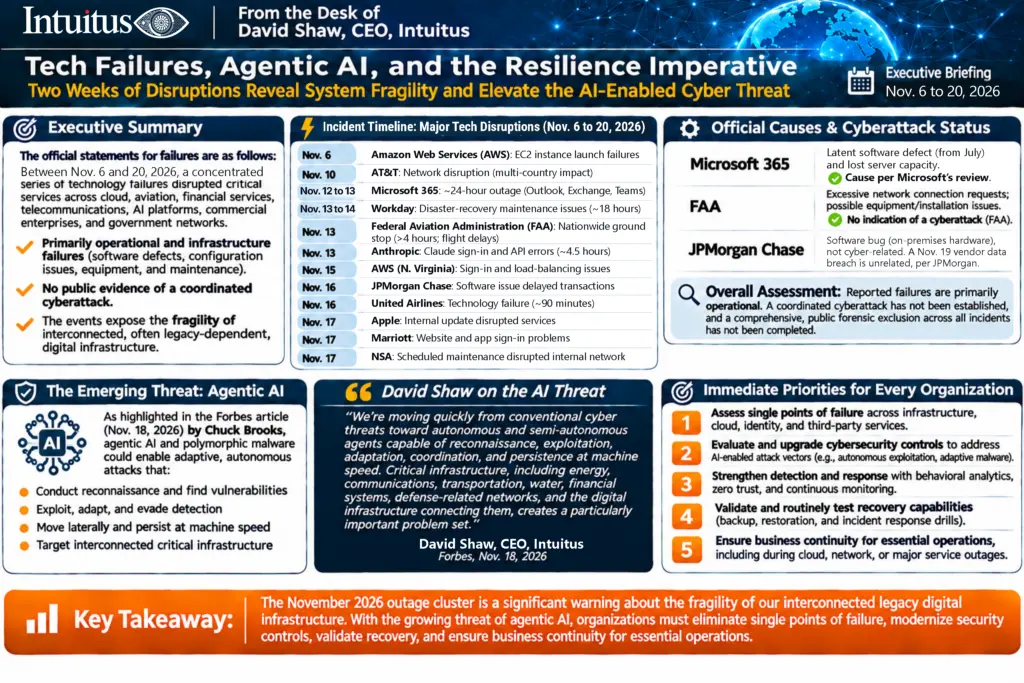
Think about that for a moment. These are organizations with enormous technology budgets, highly skilled engineering teams, and resources that most small and midsize businesses can only dream of having. Yet their systems still failed. So, what does that say about the technology environments supporting the average small or midsize business?
I believe it tells us something we’ve known for a long time but haven’t been willing to confront. Our technology infrastructure is far more fragile than most organizations realize. And we’re becoming more dependent on it every day.
Technology failures become business failures
Look at how businesses operate today. We depend on cloud providers for our applications, telecommunications companies for connectivity, third-party platforms for financial transactions, and a collection of interconnected systems to keep everything running. Much of this technology was never originally designed to operate in the highly integrated environments we have today. Legacy infrastructure continues to support modern applications, and many businesses have little understanding of where their critical dependencies actually exist.
When one component fails, the impact can extend well beyond that individual system. We’ve just watched that happen repeatedly. And while the recent disruptions have different reported causes, they share an important characteristic: technology failures can quickly become business failures.
For a large enterprise, an outage can mean millions of dollars in lost productivity and revenue. For a small business, it can mean something far worse. It can threaten the business itself. Many SMBs don’t have redundant infrastructure, dedicated security operations teams, tested recovery procedures, or the financial resources to withstand an extended disruption. They are often operating with aging systems, limited IT personnel, and outsourced technology providers that may be supporting dozens or hundreds of other customers. When something goes wrong, there may not be a second option. That’s a serious problem, and one that deserves much more attention from business leadership.
Agentic AI raises the stakes
As concerning as these technology failures are, another development makes the situation considerably more troubling. On November 18, cybersecurity author Chuck Brooks published an article in Forbes titled An Alarming Cyber Threat: Agentic Polymorphic Malware May Already Be Here. Chuck addresses an emerging threat involving agentic artificial intelligence and polymorphic malware. The technology is evolving quickly, and the implications for cybersecurity are significant.
We’ve spent decades building defenses against cyberattacks that generally follow recognizable patterns. We identify malicious software, look for suspicious activity, investigate vulnerabilities, and respond to threats based on what we know. That approach is becoming increasingly difficult to sustain on its own. Agentic AI introduces the possibility of systems that can independently perform reconnaissance, identify vulnerabilities, adjust attack methods, and continue pursuing an objective with less direct human involvement. Combine those capabilities with malware that can change its characteristics to avoid detection, and you begin to understand why the cybersecurity community is concerned.
We’re not simply talking about another variation of ransomware or phishing. We’re talking about the potential for attacks that can adapt as they encounter defensive measures. In Chuck’s Forbes article, I made the following observation:
We’re moving quickly from conventional cyber threats toward autonomous and semi-autonomous agents capable of reconnaissance, exploitation, adaptation, coordination, and persistence at machine speed.
David Shaw, in Forbes, 18 November 2026
That is where I believe the threat environment is heading.
To be clear, the full capabilities of autonomous, self-modifying agentic malware have not been conclusively established in the publicly documented incidents discussed in the article. But AI-assisted offensive activity is already a legitimate concern, and the direction of this technology should not be ignored. The question isn’t whether AI will influence cyberattacks. It already is. The question is how quickly these capabilities will mature and whether businesses will be prepared to defend against them.
Questions every business owner should be asking
Here’s what concerns me most. The small and midsize business community represents an enormous portion of our economy. These companies manufacture products, provide professional services, support healthcare, manage logistics, and serve as suppliers and subcontractors to some of our nation’s most important industries. Many are also connected directly or indirectly to critical infrastructure. Yet the majority don’t have anything approaching the cybersecurity resources of a large enterprise. They may have a firewall, endpoint protection, cloud backups, and an outsourced IT provider.
Those are all important. But having security products installed doesn’t necessarily mean you have an effective cybersecurity program.
- Can your organization identify a compromised identity before an attacker gains access to additional systems?
- Can you detect suspicious activity that doesn’t match a known malware signature? Can you contain a threat outside normal business hours?
- Can you recover your critical applications if your primary cloud provider becomes unavailable?
- And perhaps most importantly, do you actually know how long your business can operate without the technology it depends on?
These aren’t theoretical questions. They’re questions every business owner should be asking right now. AI-enabled attacks have the potential to make this problem worse by allowing adversaries to automate activities that previously required considerably more time and effort. An attacker doesn’t necessarily have to spend days manually investigating a small business network if automated tools can identify exposed services, weak credentials, vulnerable systems, and an easy way to get through the cybersecurity kill chain. That changes the economics of cybercrime. And it puts organizations with limited security resources at a distinct disadvantage.
Not a cyberattack, but a warning
I want to make an important distinction here. There is no established public evidence that the collection of technology outages we’ve seen over the past two weeks was the result of a coordinated cyberattack. Microsoft attributed its disruption to a software defect and capacity-related issues. The FAA indicated that its initial findings showed no evidence of a cyberattack. Other incidents have been associated with software, network, maintenance, or service-related problems. We shouldn’t turn every technology failure into a cybersecurity conspiracy. That doesn’t help anyone.
But I also don’t believe we should dismiss what these incidents are telling us. If our interconnected technology environments can experience this level of disruption through ordinary operational failures, imagine what happens when an intelligent, adaptive adversary deliberately targets those same weaknesses. That’s the concern! And it’s why I believe the apparent fragility of our technology infrastructure and the emergence of agentic AI need to be discussed together. One exposes the weaknesses in the systems we depend on. The other introduces the possibility of exploiting those weaknesses with increasing speed and sophistication. That combination should concern every executive responsible for keeping a business operational.
What SMB leadership should address now
For years, many small and midsize businesses have treated cybersecurity as an IT expense. Buy the firewall. Install antivirus. Back up the data. Hire an IT company. Check the box. Unfortunately, that approach is no longer sufficient. Business owners need to understand that cybersecurity and operational resilience are directly connected.
You can’t separate the security of your technology from your ability to operate your business. At Intuitus, we’ve consistently advocated looking at cybersecurity from a business risk perspective, not simply from the standpoint of which products an organization has purchased. There are several areas I believe SMB leadership should be addressing immediately.
- First, understand where your business is vulnerable to a single point of failure. Look at your cloud providers, internet connectivity, critical applications, identity systems, and third-party dependencies. Know what stops working when one of those services goes down.
- Second, take another look at your cybersecurity capabilities. Not just the products you own, but what those products and services actually do. Can they identify unusual behavior… particularly AI intrusions? Can they detect compromised accounts? Can they stop an attacker from moving through your environment? What about your supply chain… is it protected?
- Third, recognize that cyber threats don’t operate on a nine-to-five schedule. Continuous monitoring, detection, and response are increasingly important. AI can help accelerate those capabilities, but I firmly believe that security operations must remain human-led, with experienced professionals making critical decisions.
- Fourth, test your ability to recover. Having backups is one thing. Knowing you can restore your systems, recover your information, and resume operations within an acceptable period is something entirely different.
Finally, make cybersecurity and business continuity an executive responsibility. Your CEO, CFO, and leadership team need to understand the exposure. They need to know what an extended outage would cost and what resources are required to reduce that risk. None of this means every SMB needs to build an enterprise-scale cybersecurity operation. It does mean every SMB needs a realistic understanding of its risks and a practical plan to address them.
Why the internet is on fire
I’ve used the expression “the internet is on fire” because I believe it reflects the urgency of what we’re seeing. Not because every outage is a cyberattack. Not because AI has suddenly made every existing cybersecurity defense obsolete. But because we’re watching several troubling developments converge. Our businesses are increasingly dependent on interconnected technology that has demonstrated significant operational fragility. Threat actors are gaining access to more capable automation and AI-assisted attack techniques. And a substantial portion of the SMB market is still relying on security practices and recovery capabilities that may not be adequate for either challenge. That’s not a comfortable position to be in.
I believe the recent technology failures should be viewed as a severe warning. They’ve shown us what can happen when the systems we take for granted stop working, even temporarily. The emergence of agentic AI raises the stakes further. For the SMB community, the time to address these issues is before the next disruption, not after.
We need to understand our dependencies, strengthen our defenses, validate our recovery capabilities, and make sure the people responsible for protecting our organizations have the visibility and resources to do their jobs. Most importantly, we need to stop assuming that because our technology worked yesterday, it will work tomorrow. The real question for business leadership is no longer simply whether we can prevent the next cyberattack or technology failure. It’s whether our businesses can continue operating, recover, and survive when prevention fails.
That’s the conversation I believe we need to be having. And we need to be having it now.
References: Chuck Brooks, Forbes, November 18, 2026: An Alarming Cyber Threat: Agentic Polymorphic Malware May Already Be Here. Intuitus Executive Briefing, November 20, 2026: Tech Failures, Agentic AI, and the Resilience Imperative (above).