
From the Desk of Melissa Irace, CISO
This week’s threat activity reinforces an important reality: attackers increasingly don’t need to defeat your security technology — they exploit the technologies and credentials your organization already trusts.
Identity systems, administrative tools, network infrastructure, development pipelines, and operational technology are becoming pathways to business disruption. The priority for leaders is therefore broader than preventing compromise. Organizations need to know whether their defenses work, whether they can contain an attack quickly, and whether critical operations can continue when technology is disrupted.
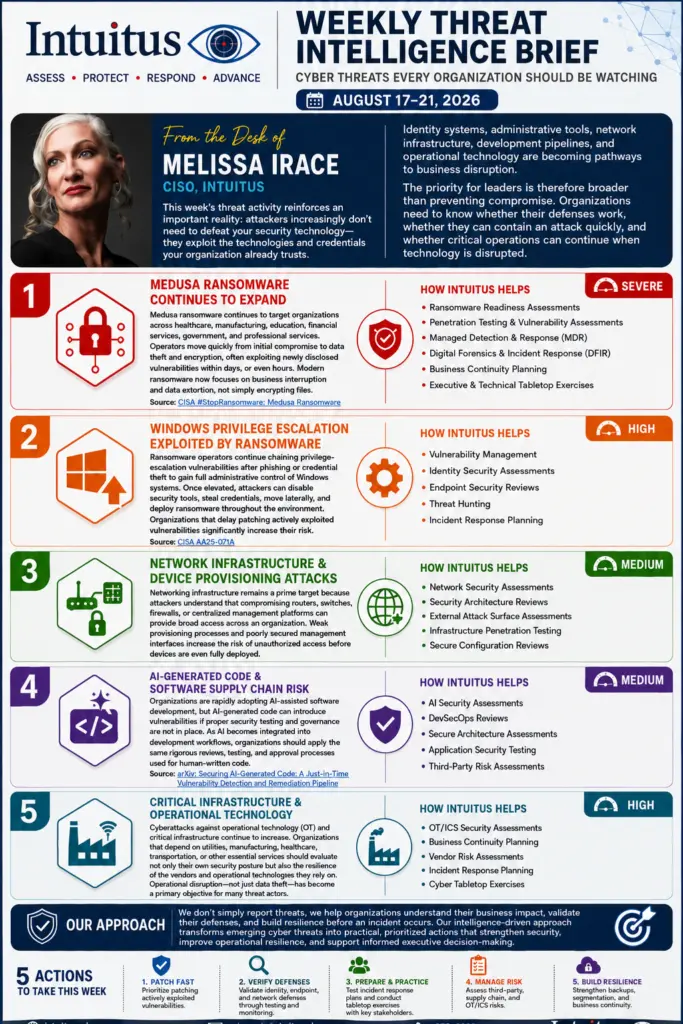
This week’s threats
01 · Severe
Medusa ransomware continues to expand
Medusa ransomware continues to target organizations across healthcare, manufacturing, education, financial services, government, and professional services. Operators move quickly from initial compromise to data theft and encryption, often exploiting newly disclosed vulnerabilities within days, or even hours. Modern ransomware now focuses on business interruption and data extortion, not simply encrypting files.
How Intuitus helps
- Ransomware Readiness Assessments
- Penetration Testing & Vulnerability Assessments
- Managed Detection & Response (MDR)
- Digital Forensics & Incident Response (DFIR)
- Business Continuity Planning
- Executive & Technical Tabletop Exercises
Source: CISA, “#StopRansomware: Medusa Ransomware”
02 · High
Windows privilege escalation exploited by ransomware
Ransomware operators continue chaining privilege-escalation vulnerabilities after phishing or credential theft to gain full administrative control of Windows systems. Once elevated, attackers can disable security tools, steal credentials, move laterally, and deploy ransomware throughout the environment. Organizations that delay patching actively exploited vulnerabilities significantly increase their risk.
How Intuitus helps
- Vulnerability Management
- Identity Security Assessments
- Endpoint Security Reviews
- Threat Hunting
- Incident Response Planning
Source: CISA, advisory AA25-071A
03 · Medium
Network infrastructure and device provisioning attacks
Networking infrastructure remains a prime target because attackers understand that compromising routers, switches, firewalls, or centralized management platforms can provide broad access across an organization. Weak provisioning processes and poorly secured management interfaces increase the risk of unauthorized access before devices are even fully deployed.
How Intuitus helps
- Network Security Assessments
- Security Architecture Reviews
- External Attack Surface Assessments
- Infrastructure Penetration Testing
- Secure Configuration Reviews
04 · Medium
AI-generated code and software supply chain risk
Organizations are rapidly adopting AI-assisted software development, but AI-generated code can introduce vulnerabilities if proper security testing and governance are not in place. As AI becomes integrated into development workflows, organizations should apply the same rigorous reviews, testing, and approval processes used for human-written code.
How Intuitus helps
- AI Security Assessments
- DevSecOps Reviews
- Secure Architecture Assessments
- Application Security Testing
- Third-Party Risk Assessments
Source: arXiv, “Securing AI-Generated Code: A Just-in-Time Vulnerability Detection and Remediation Pipeline”
05 · High
Critical infrastructure and operational technology
Cyberattacks against operational technology (OT) and critical infrastructure continue to increase. Organizations that depend on utilities, manufacturing, healthcare, transportation, or other essential services should evaluate not only their own security posture but also the resilience of the vendors and operational technologies they rely on. Operational disruption — not just data theft — has become a primary objective for many threat actors.
How Intuitus helps
- OT/ICS Security Assessments
- Business Continuity Planning
- Vendor Risk Assessments
- Incident Response Planning
- Cyber Tabletop Exercises
Our approach
We don’t simply report threats. We help organizations understand their business impact, validate their defenses, and build resilience before an incident occurs. Our intelligence-driven approach transforms emerging cyber threats into practical, prioritized actions that strengthen security, improve operational resilience, and support informed executive decision-making.
Five actions to take this week
- Patch fast. Prioritize patching actively exploited vulnerabilities.
- Verify defenses. Validate identity, endpoint, and network defenses through testing and monitoring.
- Prepare and practice. Test incident response plans and conduct tabletop exercises with key stakeholders.
- Manage risk. Assess third-party, supply chain, and OT/ICS risks.
- Build resilience. Strengthen backups, segmentation, and business continuity.