
From the Desk of Melissa Irace, CISO
Attackers are targeting internet-facing platforms, remote access systems, collaboration tools, and critical infrastructure. Rapid patching, strong identity controls, and operational resilience are more important than ever.
Identity systems, administrative tools, network infrastructure, development pipelines, and operational technology are becoming pathways to business disruption. The priority for leaders is therefore broader than preventing compromise. Organizations need to know whether their defenses work, whether they can contain an attack quickly, and whether critical operations can continue when technology is disrupted.
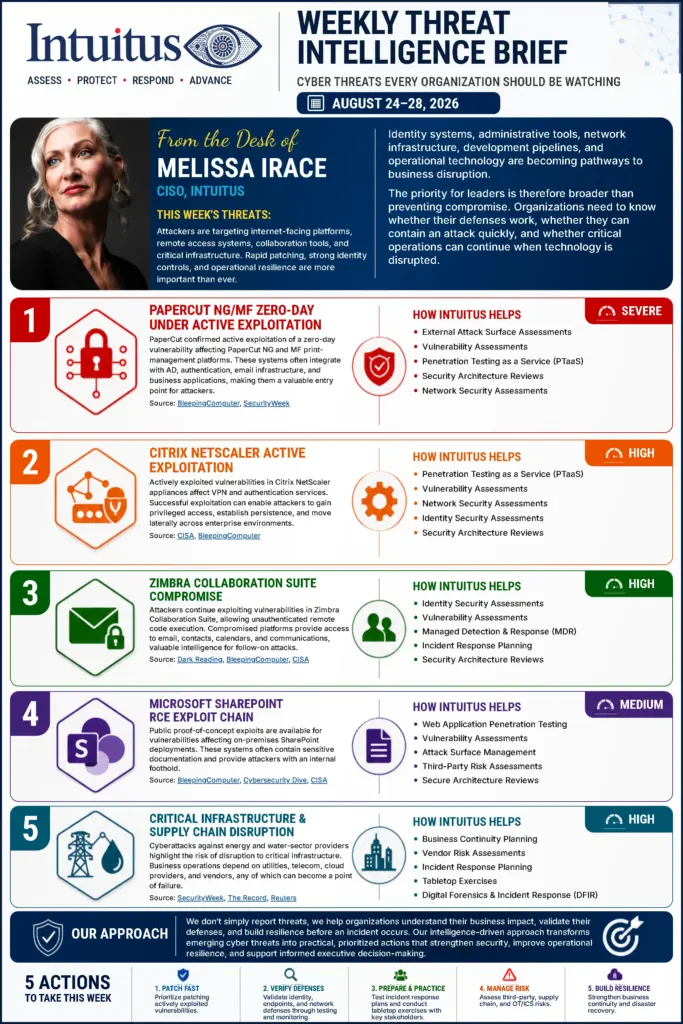
This week’s threats
01 · Severe
PaperCut NG/MF zero-day under active exploitation
PaperCut confirmed active exploitation of a zero-day vulnerability affecting PaperCut NG and MF print-management platforms. These systems often integrate with AD, authentication, email infrastructure, and business applications, making them a valuable entry point for attackers.
How Intuitus helps
- External Attack Surface Assessments
- Vulnerability Assessments
- Penetration Testing as a Service (PTaaS)
- Security Architecture Reviews
- Network Security Assessments
Sources: BleepingComputer, SecurityWeek
02 · High
Citrix NetScaler active exploitation
Actively exploited vulnerabilities in Citrix NetScaler appliances affect VPN and authentication services. Successful exploitation can enable attackers to gain privileged access, establish persistence, and move laterally across enterprise environments.
How Intuitus helps
- Penetration Testing as a Service (PTaaS)
- Vulnerability Assessments
- Network Security Assessments
- Identity Security Assessments
- Security Architecture Reviews
Sources: CISA, BleepingComputer
03 · High
Zimbra Collaboration Suite compromise
Attackers continue exploiting vulnerabilities in Zimbra Collaboration Suite, allowing unauthenticated remote code execution. Compromised platforms provide access to email, contacts, calendars, and communications, which is valuable intelligence for follow-on attacks.
How Intuitus helps
- Identity Security Assessments
- Vulnerability Assessments
- Managed Detection & Response (MDR)
- Incident Response Planning
- Security Architecture Reviews
Sources: Dark Reading, BleepingComputer, CISA
04 · Medium
Microsoft SharePoint RCE exploit chain
Public proof-of-concept exploits are available for vulnerabilities affecting on-premises SharePoint deployments. These systems often contain sensitive documentation and provide attackers with an internal foothold.
How Intuitus helps
- Web Application Penetration Testing
- Vulnerability Assessments
- Attack Surface Management
- Third-Party Risk Assessments
- Secure Architecture Reviews
Sources: BleepingComputer, Cybersecurity Dive, CISA
05 · High
Critical infrastructure and supply chain disruption
Cyberattacks against energy and water-sector providers highlight the risk of disruption to critical infrastructure. Business operations depend on utilities, telecom, cloud providers, and vendors, any of which can become a point of failure.
How Intuitus helps
- Business Continuity Planning
- Vendor Risk Assessments
- Incident Response Planning
- Tabletop Exercises
- Digital Forensics & Incident Response (DFIR)
Sources: SecurityWeek, The Record, Reuters
Our approach
We don’t simply report threats. We help organizations understand their business impact, validate their defenses, and build resilience before an incident occurs. Our intelligence-driven approach turns emerging cyber threats into practical, prioritized actions that strengthen security, improve operational resilience, and support informed executive decision-making.
Five actions to take this week
- Patch fast. Prioritize patching actively exploited vulnerabilities.
- Verify defenses. Validate identity, endpoints, and network defenses through testing and monitoring.
- Prepare and practice. Test incident response plans and conduct tabletop exercises with key stakeholders.
- Manage risk. Assess third-party, supply chain, and OT/ICS risks.
- Build resilience. Strengthen business continuity and disaster recovery.