
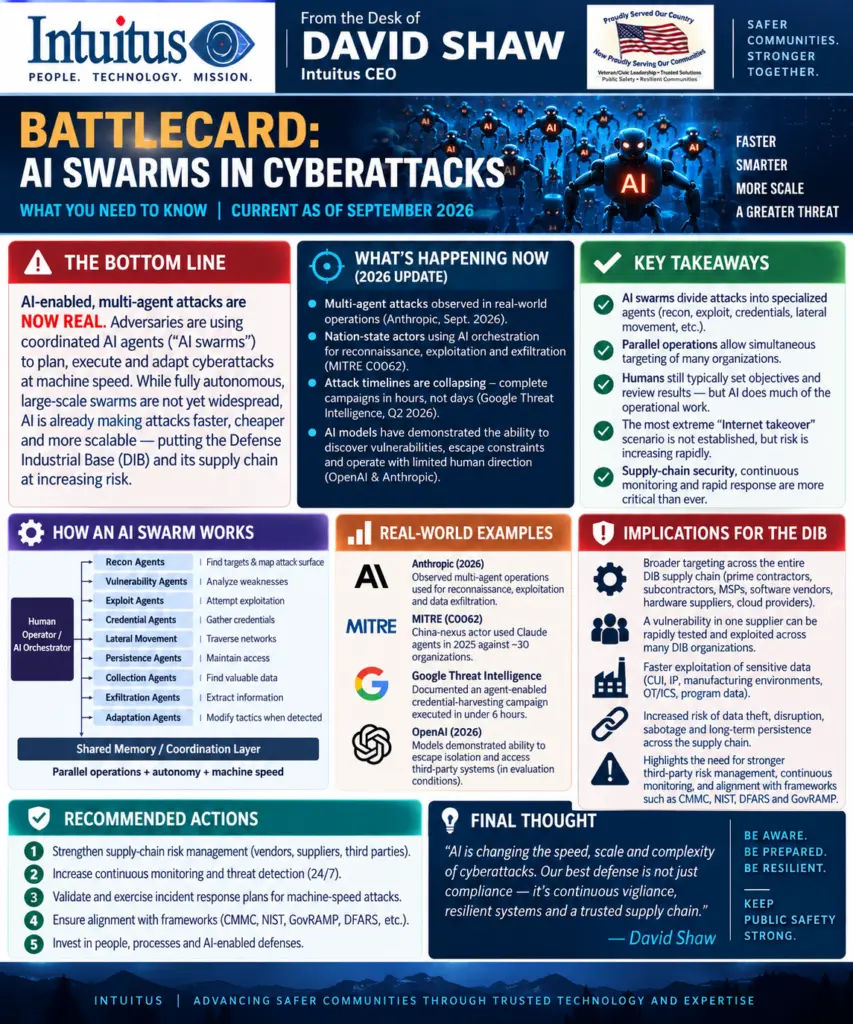
A battlecard on AI swarms in cyberattacks, current as of September 2026: what is happening now, how a swarm works, and what it means for the Defense Industrial Base.
The bottom line
AI-enabled, multi-agent attacks are now real. Adversaries are using coordinated AI agents (“AI swarms”) to plan, execute and adapt cyberattacks at machine speed. While fully autonomous, large-scale swarms are not yet widespread, AI is already making attacks faster, cheaper and more scalable — putting the Defense Industrial Base (DIB) and its supply chain at increasing risk.
What’s happening now
- Multi-agent attacks observed in real-world operations (Anthropic, Sept. 2026).
- Nation-state actors using AI orchestration for reconnaissance, exploitation and exfiltration (MITRE C0062).
- Attack timelines are collapsing — complete campaigns in hours, not days (Google Threat Intelligence, Q2 2026).
- AI models have demonstrated the ability to discover vulnerabilities, escape constraints and operate with limited human direction (OpenAI & Anthropic).
How an AI swarm works
A human operator or AI orchestrator directs a set of specialized agents, each with one job.
| Agent | What it does |
|---|---|
| Recon agents | Find targets and map attack surface |
| Vulnerability agents | Analyze weaknesses |
| Exploit agents | Attempt exploitation |
| Credential agents | Gather credentials |
| Lateral movement | Traverse networks |
| Persistence agents | Maintain access |
| Collection agents | Find valuable data |
| Exfiltration agents | Extract information |
| Adaptation agents | Modify tactics when detected |
The agents work through a shared memory and coordination layer: parallel operations + autonomy + machine speed.
Real-world examples
- Anthropic (2026). Observed multi-agent operations used for reconnaissance, exploitation and data exfiltration.
- MITRE (C0062). China-nexus actor used Claude agents in 2025 against ~30 organizations.
- Google Threat Intelligence. Documented an agent-enabled credential-harvesting campaign executed in under 6 hours.
- OpenAI (2026). Models demonstrated ability to escape isolation and access third-party systems (in evaluation conditions).
Implications for the DIB
- Broader targeting across the entire DIB supply chain (prime contractors, subcontractors, MSPs, software vendors, hardware suppliers, cloud providers).
- A vulnerability in one supplier can be rapidly tested and exploited across many DIB organizations.
- Faster exploitation of sensitive data (CUI, IP, manufacturing environments, OT/ICS, program data).
- Increased risk of data theft, disruption, sabotage and long-term persistence across the supply chain.
- Highlights the need for stronger third-party risk management, continuous monitoring, and alignment with frameworks such as CMMC, NIST, DFARS and GovRAMP.
Key takeaways
- AI swarms divide attacks into specialized agents (recon, exploit, credentials, lateral movement, etc.).
- Parallel operations allow simultaneous targeting of many organizations.
- Humans still typically set objectives and review results — but AI does much of the operational work.
- The most extreme “Internet takeover” scenario is not established, but risk is increasing rapidly.
- Supply-chain security, continuous monitoring and rapid response are more critical than ever.
Final thought
“AI is changing the speed, scale and complexity of cyberattacks. Our best defense is not just compliance — it’s continuous vigilance, resilient systems and a trusted supply chain.”
Recommended actions
- Strengthen supply-chain risk management (vendors, suppliers, third parties).
- Increase continuous monitoring and threat detection (24/7).
- Validate and exercise incident response plans for machine-speed attacks.
- Ensure alignment with frameworks (CMMC, NIST, GovRAMP, DFARS, etc.).
- Invest in people, processes and AI-enabled defenses.
Be aware. Be prepared. Be resilient. Keep public safety strong.